
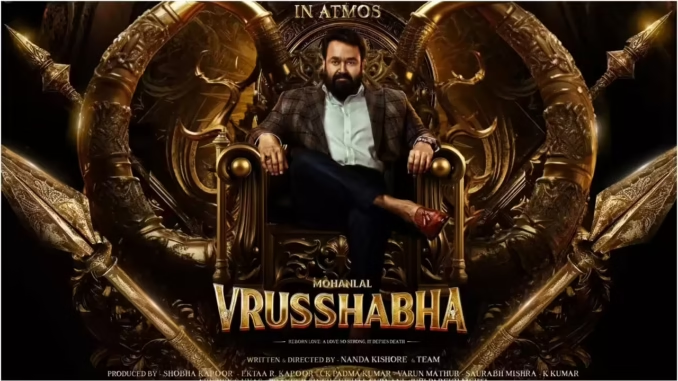
Vrusshabha feels like a ChatGPT prompt gone wrong, where the lazy ask for a sure-shot ‘Pan Indian’ blockbuster formula gives us a flimsy period epic in the guise of an incompetently drawn ‘reincarnation drama’, observes Arjun Menon.
The film rehashes the tired, breathless tropes of superior reincarnation dramas to tell the story of a father-son bond.
Mohanlal branching out time and again to other industries has been fetching diminishing returns of late.
December releases are turning out to be disastrous for Mohanlal in the past few years, with his directorial debut Barozz, Marakkar Arabikadalinte Simham and Odiyan turning out to be universally panned projects, often calling into question why these films were even made in the first place.
Vrusshabha feels like a ChatGPT prompt gone wrong, where the lazy ask for a sure-shot ‘Pan Indian’ blockbuster formula gives us a flimsy period epic in the guise of an incompetently drawn ‘reincarnation drama’.
The abysmal mounting further exacerbates the middling world-building of the whole enterprise, having actors playing dress up in ridiculously cheap-looking sets with an over dependence on greenscreen and matte backgrounds. Vijayendra Vrusshabha (Mohanlal) is a king from centuries ago, whose one fateful mistake during a battle confers upon him an unrelenting generational curse.
King Vrusshabha has been cursed of a life where his own blood, his yet unborn son, will be his sole undoing as a ruler and, more importantly, as a man.
The dark vision looms over his head.
The inevitable happens: The royal queen, his wife, Trilochan Devi (Ragini Dwivedi) gives birth to his son and all hell breaks loose.
An unfortunate series of events follows that leads to the parents losing their child.
The film then flashes forward to the current timeline, where the father and son have been reborn, sharing the same relationship in today’s world as a businessman and his son.
A vow from the son in the past timeline complicates their present relationship.
Things get awry in the current timeline as the son discovers their unusual reincarnation history.
On paper, the idea of a feverish curse from a previous life coming back to haunt a now clueless father and son dynamic are fertile enough for a skilful examination of some pulpy psychoanalytical and fantasy genre mashup exercise.
But Vrusshabha is too distracted and dated to work any sense of rhythm or pacing to such a mythical premise.
There is a ‘plastic aesthetic’ at work here, too jarring and old school to work in this day and age, where blockbusters have set the bar high with imaginative repurposing of age-old genre conventions. Every visual detail and scene idea feels borrowed and weightless.
A less imaginative, contrived version of a better S S Rajamouli film, the writing is maudlin and run-down here.
The thing with films like Maghadheera is that the film-making amplifies the inherent tension of the ludicrous plot twists with the sheer force and conviction of its epic scope.
In the case of Vrusshabha, Director Nanda Kishore paints with the broadest of strokes and is the least bit curious or faithful to the epic sensationalism of his time, jumping the ‘reincarnation’ formula as a means and as an end. He doesn’t have much leeway in terms of thematic ideas or strong thesis statements to be made.
Every plot point is a meandering exercise in plot progression.
The film confuses incidents for momentum and throws in zeitgeisty, Hindu philosophy-related ramblings, moral lectures on the essence of right and wrong, and waywardly placed action sequences in its effort to fill out the gaping holes in the mythic drama in the background. Everything is spelt out, and nothing is held back or delivered with any finesse.
There is no dramatic weight to the way these disparate elements have been strung together, and the film ends up being a toothless ‘dress up’ drama, where people deliver clumsy monologues with equally tired conviction.
Mohanlal, who has been having a banger year in 2025, except for the abysmal cameo in the multi-starrer Kannappa, is not able to salvage this film.
He feels out of place and out of time in a film that does not utilise a performer of his calibre.
Mohanlal is unable to translate the unfocused character beats and superficial lines into any sort of narrative cohesion or heightened believability. He feels miscast as the conflicted father, whose relationship with his son is thinly sketched.
The hinge point of the conflict, with ‘Vrusshabha’ and ‘Aadi Deva Varma’ (the father from the present timeline) and their two selves and their relation to the son, is not even given enough time in the script to percolate.
Mohanlal can only do so much to infuse some gravity into such a caricaturish creation.
His persona can make the ‘compassionate father caught in a moral dilemma’ work to an extent but he is not supported by the writing or supporting performances.
The multi-language release strategy also does not help, as we can clearly see actors mouthing possibly Malayalam lines with the other language version dialogues.
No idea how these scenes were shot and put together.
None of the performances feel lived in or acclimatised to the vision (or lack thereof) of the world of Vrusshabha.
Every character moment and plot line is in service of a story that does not take off at all, hence nullifying its own potential.
Sam C S tries to shake the film into some sort of auditory cohesion, but his score loses its life with repetition and overuse.
The frames are all over-lit, and the production design is maximalist to a fault.
Much of the fantasy sequences look contrived, and the imagery has the glassy, fake look of a low-tier commercial, especially in the action scenes.
Vrusshabha is a miss for many reasons.
Its staunch conservative streak, its questionable plot developments, its hazy use of religious symbolism and references that are disjointed and its infuriating lack of discipline or cogent storytelling can equally be blamed.
But the saddest takeaway is the lazy approach in the film’s execution.
Storytelling can aim for the sky and reinstate lively energy into dated ideas and ways of telling stories.
There is nothing inherently wrong with that conviction.
But the sheer lack of effort in populating such a bloated blockbuster bait with any meaningfully human ideas becomes the undoing of this lacklustre storytelling.
Discover more from GLOBAL MOVIE
Subscribe to get the latest posts sent to your email.
Leave a Reply